
The Missing Link in Pelvic Health
Why Strength Alone Was Never The Full
Download your worksheet Link (add a tokin images of a worksheet)
Click Play to listen to audio module on site.
01 MODULE
Listen offline or on your phone. Click the download button and Save to your location choice. If you lose it, look in your Downloads folder.
01 MODULE
Before You Begin
Take a breath before you start and let your system settle. I know your journey may have felt aggravating and lonely so far, and I want you to know you’re not alone here.
You aren’t fixing anything today, and you don’t need to remember everything you read. This module is about understanding and awareness, not effort.
In this lesson, you’ll begin to see your pelvic floor not as a single muscle to “strengthen,” but as part of a larger system involving breathing, pressure, nerves, hormones, and daily habits.
MODULE 1
The Integrated Pelvic System
WHAT YOUR DOCTOR DIDN'T TELL YOU
intro: Strength Alone Was Never the Answer
The Lies Your Doctor Told You
If you've ever leaked while laughing with friends and then spent the rest of the gathering wondering if anyone noticed...
If you've timed your grocery runs around bathroom access...
If you've heard "just do Kegels" from three different doctors and nothing changed...
There's nothing wrong with you.
The advice you were given was incomplete.
For decades, women have been handed the same reductive advice: "Your pelvic floor is weak. Squeeze harder." But here's what almost no one tells you: for many women over 45, the problem isn't weakness at all.
Modern research in pelvic physical therapy reveals something surprising, and liberating. Many women dealing with leaks actually have pelvic floors that are too tight, not too loose.
Muscles that are chronically clenched, exhausted, and unable to relax.
Imagine trying to strengthen a fist that's been clenched for years. You'd never tell someone, "Just make a tighter fist!" You'd help them open their hand first, right? That's what traditional Kegel advice does to an already overworked pelvic floor. It asks an exhausted muscle to work even harder.
A study published in the Journal of Women's Health Physical Therapy found that for many women, the real issue isn't weakness but something called hypertonicity. That means muscles that are too tight and can't relax. If you try to strengthen a muscle that is already exhausted and cramped, you actually decrease its function. It's like revving an engine that's already overheating.
This module will show you why the "weakness myth" keeps you stuck, and introduce you to the real system at play: An integrated network of breathing, Pressure management, Hormones, and Nervous system communication that no one taught you about in health class.
By the end of this lesson, you'll understand:
- Why your body isn't failing you (it's responding exactly as designed under stress)
- The surprising role your breathing and posture play in leaks
- Why squeezing harder might be making things worse
- How hormones, inflammation, and emotions all feed into pelvic symptoms
- What "pelvic floor intelligence" actually means (HINT: it's not about strength)
Let's start by looking at what your pelvic floor actually is, and what it's been trying to tell you.
SECTION 1: Your Core as a Pressure System
Not Just Your "Abs"
To truly understand why you leak when you cough, sneeze, or laugh, you need to stop thinking about your pelvic floor as one isolated muscle group sitting at the bottom of your pelvis, doing its own thing.
Think of your core as a pressurized canister, like a soda can. When that can is functioning well, pressure is distributed evenly across all sides. But if one side is dented or the seal is compromised, pressure finds the weak spot and escapes.
Pop. Fizz. Leak.
Your "core canister" has four walls, and they're supposed to work together as a team:
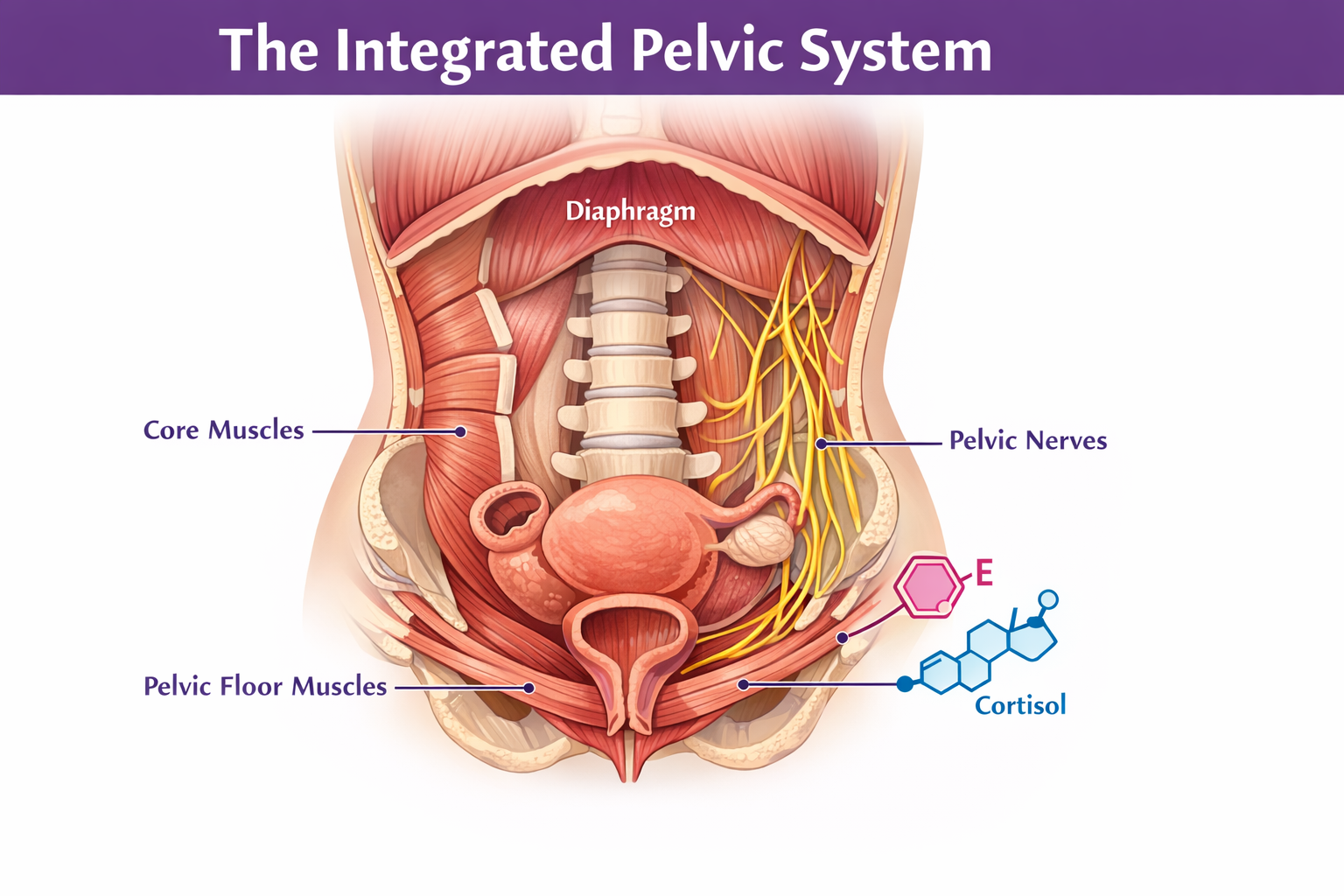
The Top
Your Diaphragm
This is your primary breathing muscle. It sits like an upside; down bowl (or an umbrella) just under your ribs. Every time you breathe in, it moves. Every time you breathe out, it moves again. It's not just for breathing. It's a structural player in your core stability.
The Bottom
Your Pelvic Floor
This is a group of 14 muscles arranged in three layers. They sit at the base of your pelvis, forming a sort of hammock or trampoline. But unlike a hammock (which is static), your pelvic floor is dynamic. It's constantly adjusting to changes in pressure, movement, and position.
The Sides
Your Deepest Abdominal Layer
This is called the transverse abdominis, or TVA. It's like a natural corset that wraps horizontally around your midsection. You can't see it (it's under your six-pack muscles), but it's one of the most important muscles for spinal stability and pressure control.
The Back
Your Deep Spinal Stabilizers
These are tiny muscles (like the multifidus) that run along your spine, helping to keep each vertebra stable and stacked. They're small but mighty.
Here's the part that changes everything: these four parts are supposed to move together, like a piston in an engine.
The Piston Mechanism
How It's Supposed to Work
When you inhale, your diaphragm contracts and moves downward (it descends into your belly). To keep the pressure balanced in the canister, your pelvic floor has to gently lengthen and lower too. This is called eccentric lengthening. Think of it like the pelvic floor "accepting" the pressure from above by softly dropping down and widening out.
When you exhale, your diaphragm moves back up toward your ribs, and your pelvic floor lifts back up with it. This is called concentric contraction. It's the "squeeze" or "lift" you might associate with a Kegel.
In a healthy system, this happens automatically. You don't think about it. Your diaphragm and pelvic floor are in constant communication, moving in sync with every breath you take. This is called diaphragmatic; pelvic synchrony, and it's one of the most important concepts in modern pelvic health.
But What Happens When This Rhythm Breaks?
Here's where things go sideways for a lot of women.
Maybe you've spent years holding your stomach in because you wanted to look thinner. (No judgment. We've all done it.) But when you constantly "brace" your abs, you're essentially locking one side of the canister. The transverse abdominis can't move freely.
Or maybe you're a shallow chest breather. You take quick, short breaths up in your shoulders instead of deep belly breaths. This happens a lot with chronic stress, anxiety, or even just being busy and distracted all day. When you breathe this way, your diaphragm barely moves. So your pelvic floor never gets the signal to lengthen and lift in rhythm.
Or maybe you've had abdominal surgery (C-section, gallbladder removal, hysterectomy). Scar tissue and changes in how your muscles fire can disrupt the coordination of the whole system.
When the piston gets stuck or out of sync, pressure has nowhere to go except down, right onto your pelvic floor.
Over time, this constant downward pressure overwhelms the system. It's like asking one person to hold up a roof when there should be four support beams. Eventually, something gives. You leak. You feel heaviness. You might feel like "something is falling out".
This is why you can have strong muscles and still leak. It's not about strength. It's about pressure management and coordination.
Think of it this way:
You could have the strongest pelvic floor muscles in the world, but if the pressure coming down on them is greater than what they can handle in that moment, they'll fail. It's physics. And no amount of squeezing will fix a broken pressure system.
Section 2: The Three Layers of Your Pelvic Floor
Why It Matters
We often talk about "the pelvic floor" like it's one thing. One muscle. One job. But it's actually three distinct layers, stacked on top of each other like a cake, and each layer has a different role.
Understanding these layers helps you see why "just do Kegels" is like saying "just use your arm" when someone asks how to play piano. Which part of your arm? Your shoulder? Your elbow? Your fingers? It matters.
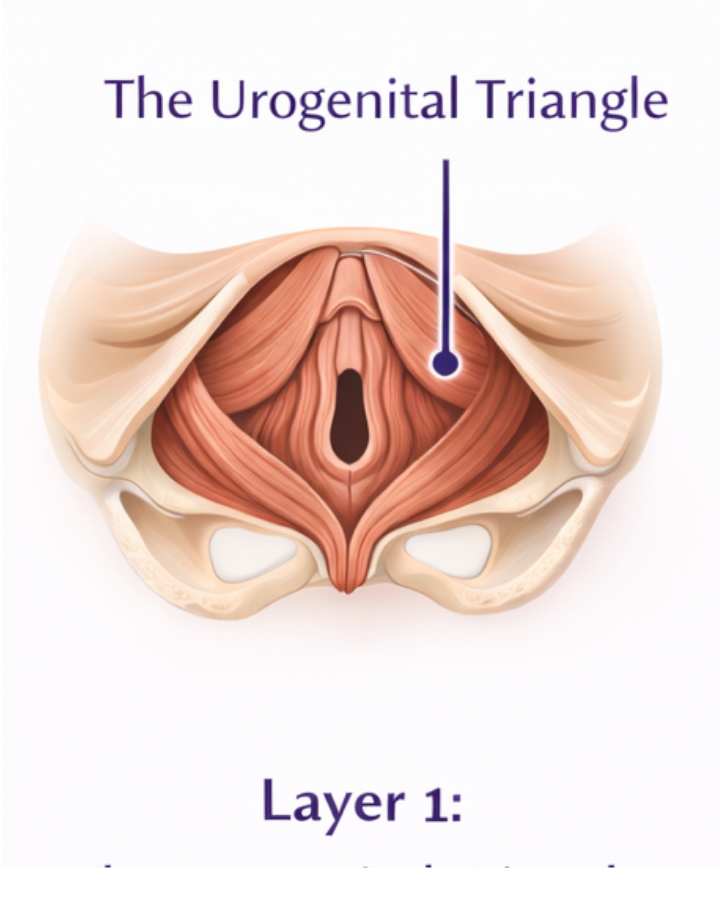
Layer 1:
The Urogenital Triangle (The "Closers")
This is the outermost, most superficial layer. It sits closest to the surface, right around your vaginal and urethral openings.
Its job: Sphincteric control. These muscles are the ones that literally wrap around your urethra (the tube you pee out of) and your vaginal opening. They're the "closers." When you do a quick squeeze to stop the flow of urine mid; stream (which, by the way, you shouldn't do regularly, but we'll get to that), you're using Layer 1.
Think of this layer as the emergency brake. It's fast; twitch. It's reactive. When you sneeze unexpectedly, these muscles are supposed to fire quickly to keep you from leaking.
Layer 2:
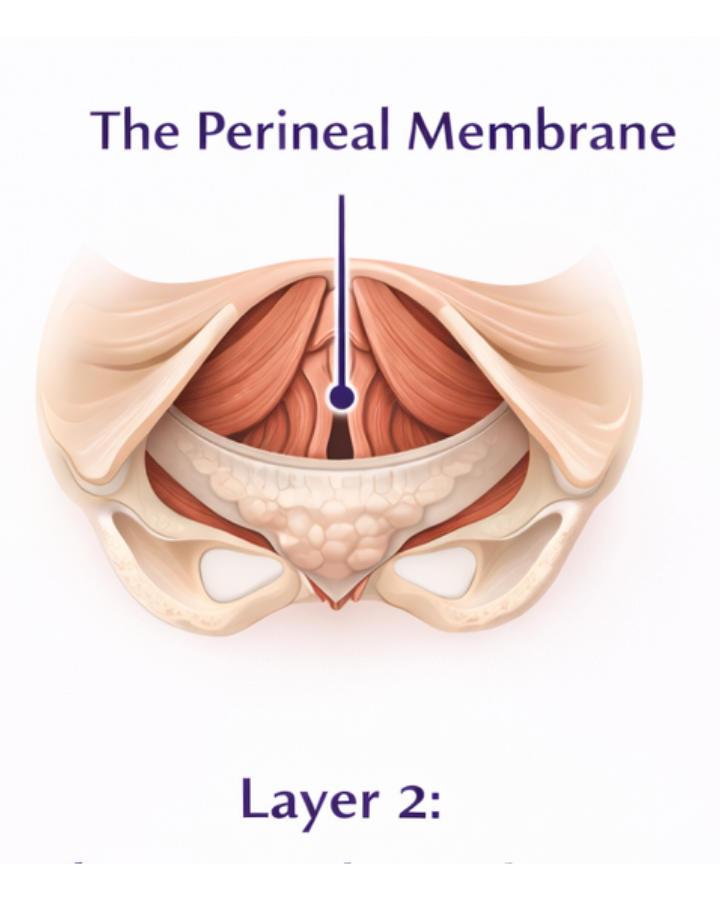
The Perineal Membrane (The "Supports")
This is the middle layer. It's a fascial (connective tissue) structure that acts like a trampoline mat, providing a foundation for the muscles above and below it.
Its job: Structural stability. It helps distribute tension across the pelvic outlet (the bottom opening of your pelvis). It's not a muscle you can "squeeze," but it's incredibly important for overall support.
Think of it like the mesh on a trampoline. If the mesh is torn or stretched out, it doesn't matter how strong the springs (the muscles) are. The system doesn't work right.
Layer 3:
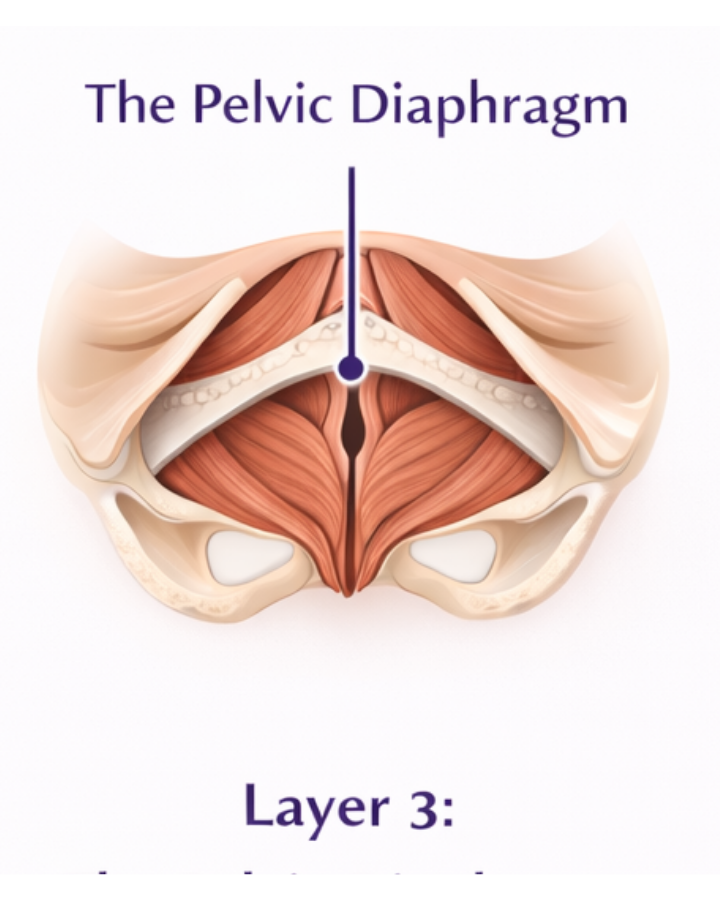
The Pelvic Diaphragm (The "Lifters")
This is the deepest and largest layer. It's made up of a group of muscles called the levator ani. These are the workhorses of the pelvic floor.
Its job: Organ support and postural stability. These muscles literally hold up your bladder, uterus (if you still have one), and rectum. They keep everything in its proper place against the pull of gravity. They also play a huge role in spinal stability and how you move through the world.
Think of this layer as the foundation of a house. If the foundation is compromised (maybe from childbirth, chronic straining, or aging), the whole structure starts to sag. This is often what's happening in prolapse, that feeling of heaviness or bulging that some women experience.
Why This Matters for You
When a woman experiences stress incontinence (leaking when you cough, sneeze, or jump), it's often a problem with Layer 1. Those fast; twitch "closer" muscles aren't firing quickly enough.
When a woman experiences prolapse (that feeling of organs dropping down), it's often a problem with Layer 3. The deep support muscles or the fascia holding them in place has been compromised.
Here's the thing: doing a generic "Kegel" (squeeze and lift) might help Layer 1, but it won't necessarily help Layer 3. And if you have a prolapse issue, you might actually need to work on lifting (Layer 3) more than closing (Layer 1).
This is why cookie cutter advice doesn't work. Your pelvic floor is complex. And it deserves a complex, thoughtful approach.
SECTION 3: Your Brain Plays a Bigger Role Than You Think
Why Your Nervous System Matters
Pelvic health isn't just about muscles. It's also about your brain and your nervous system. In fact, the pelvic floor is one of the most neurologically "loud" areas of your body. It has more nerve endings per square inch than almost anywhere else, except maybe your hands and face.
That means your brain is constantly getting feedback from your pelvis. And your pelvis is constantly responding to signals from your brain.
Let's talk about two big ways this shows up.
The Guarding Reflex: When Your Body Won't Let Go
Your pelvic floor is deeply connected to your survival response. You know the one:
FLIGHT – FIGHT - FREEZE
Think about it from an evolutionary perspective. If you're a human living in the wild and a predator appears, what's one of the first things your body does? It tightens up. You hold your breath. You clench. Your body is literally trying to protect your most vulnerable areas, including your pelvic opening.
This is called the guarding reflex, and it's hardwired into your nervous system.
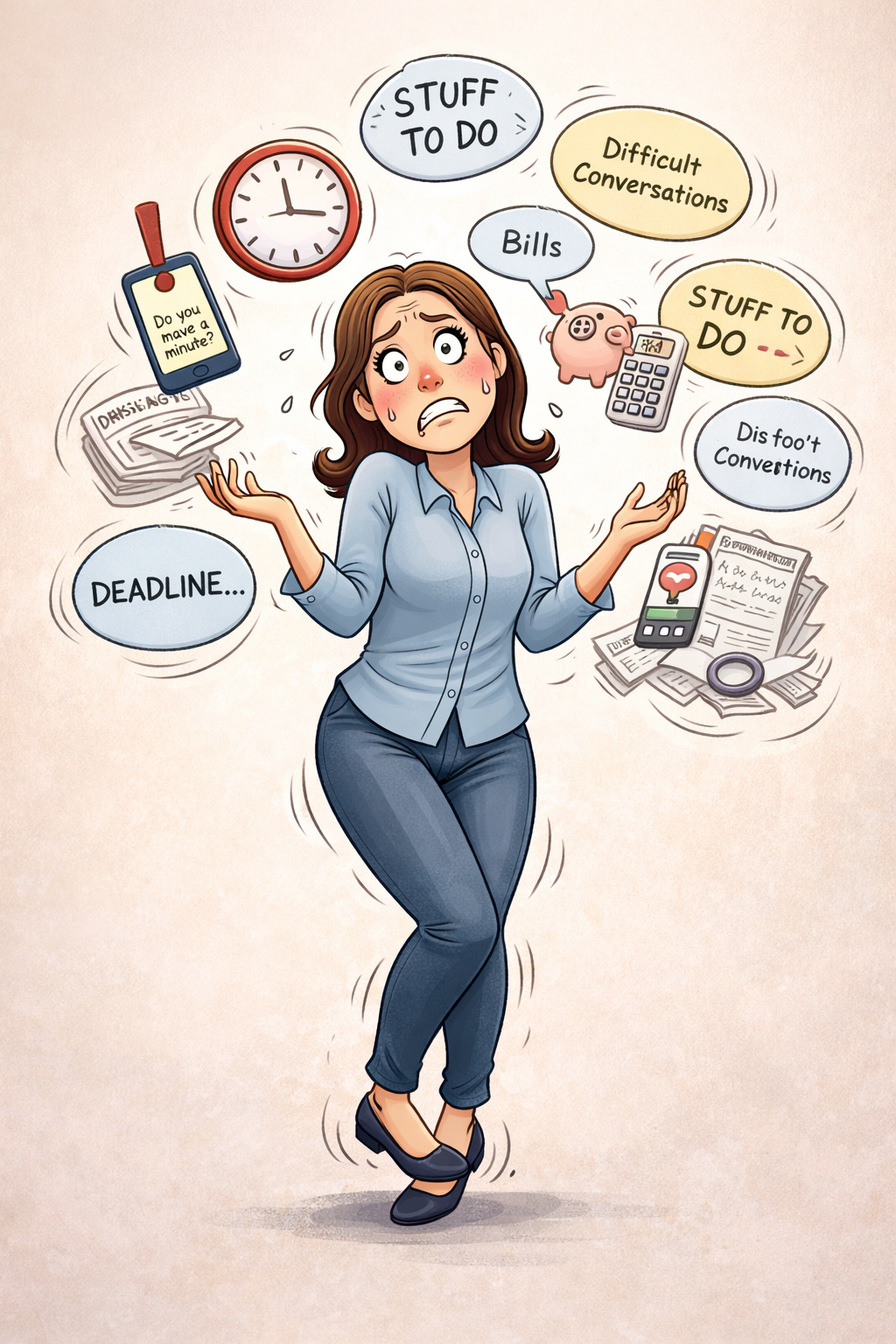
Now, here's the problem. Most of us aren't running from predators anymore. But we are running from deadlines, difficult conversations, financial stress, family drama, health worries, and a never-ending to-do list.
Your nervous system doesn't know the difference between a lion and a passive- aggressive email. Stress is stress. And if you're living in a state of chronic low- grade stress (which, let's be honest, most of us are), your brain keeps sending that same message to your pelvic floor:
Guard – Protect – Hold Tight
Over time, this creates what pelvic floor physical therapists call a high-tone pelvic floor. It's a pelvic floor that never fully relaxes. It's always at least partially contracted, like a fist that never fully opens.
You Are Already Maxed Out
And here's the cruel irony: a tight muscle is a weak muscle. If your pelvic floor is already 90% contracted all the time, it only has 10% left to give when you actually need it, like when you cough or sneeze. So you leak. Not because you're weak. But because you're already maxed out.
Overactive Bladder and the Nervous System Mismatch
Let's talk about urge incontinence. That's the sudden, desperate need to pee, even when your bladder isn't actually full. It's the "I'm not going to make it to the bathroom" panic.
For a lot of women, this isn't actually a bladder problem. It's a nervous system signaling problem.
Here's how it works:
Your bladder has stretch receptors in its wall. When your bladder fills with urine, those receptors stretch and send a signal to your brain that says, "Hey, we're getting full. Start thinking about finding a bathroom".
But if your pelvic floor is chronically tight (because of that guarding reflex we just talked about), it can irritate those stretch receptors. They start sending false alarms to your brain. "Full! Full! Full!" they scream, even when the bladder is only 20% full.
Your brain believes the signal. It sends an urgent message back: "Find a bathroom NOW".
And the cycle continues.
A study published in the Journal of Urology found that for many women with overactive bladder, treating the nervous system, calming it down, and teaching the pelvic floor to relax was often more effective than medication or traditional strengthening exercises.
This is why breathwork, mindfulness, and nervous system regulation aren't just "woo-woo" add-ons. They're foundational tools for pelvic health.
SECTION 4: Why the Old Pelvic Advice Falls Short
Why "Just Do Kegels" Is Outdated Advice
Let's get real. If you went to a physical therapist with a frozen shoulder, they wouldn't just tell you to "squeeze your shoulder harder." They'd look at your range of motion. They'd assess your posture. They'd ask about your daily habits. They'd work on releasing the tightness before building strength.
The pelvic floor is no different.
The Problem with the "Short" Muscle
A muscle has to be able to move through its full range of motion to be functional. That means it needs to be able to fully lengthen (relax and stretch) and fully contract (squeeze and lift).
If a muscle is stuck in a shortened, tight position, it's actually a weak muscle. It has nowhere to go. It can't generate force because it's already maxed out.
Many women have what we call a high-tone pelvic floor. The muscle is already 90% contracted at rest. So when they try to do a Kegel, they're asking that muscle to squeeze even more. But it can't. There's no room.
It's like trying to close a fist that's already clenched. You might feel like you're working hard, but you're not actually getting any stronger. In fact, you might be making the problem worse by increasing the tension.
The Timing Problem:
When Coordination Matters More Than Strength
Here's something most people don't know: your pelvic floor is supposed to fire before you cough or sneeze.
Not during. Before.
This is called an anticipatory postural adjustment. Your brain is supposed to sense that a pressure event is coming (like a cough) and pre-activate your pelvic floor to brace for it. This happens in milliseconds. It's automatic.
But if your timing is off, maybe because of back pain, past surgery, scar tissue, or just years of not moving well, it doesn't matter how strong your pelvic floor is. If it fires too late, you leak.
Research shows that many women with stress incontinence don't have weak muscles. They have delayed activation. The muscle strength is fine. The timing is off.
This is why doing slow, isolated Kegels (squeeze, hold for 10-seconds, release) might not translate to real-life function. Real life doesn't give you a 10-second warning before you sneeze.
The "Just Squeeze" Approach Ignores the Nervous System
We've already talked about the nervous system connection. But it's worth repeating here because it's so often overlooked.
If your pelvic floor is tight because your nervous system is stuck in "guard mode," doing more Kegels is like pressing the gas pedal when your emergency brake is on. You're not going anywhere. You're just burning out the engine.
What you actually need is to teach your nervous system that it's safe to let go. You need to down; regulate. You need to give your pelvic floor permission to relax.
And that's not something a Kegel can do.
SECTION 5: The Role of Fascia & Connective Tissue
The Part No One Talks About
We spend so much time talking about muscles. But muscles are only part of the story.
Let's talk about fascia.
Fascia is the connective tissue that wraps around and holds everything in your body. Think of it like saran wrap or a spiderweb. It's everywhere. It connects your muscles, your organs, your bones. It provides structure and support.
In your pelvis, there's a type of fascia called endopelvic fascia. This fascia is what actually suspends your organs (your bladder, uterus, rectum) from the inside walls of your pelvis.
Your muscles provide active support, they contract and move. But your fascia provides passive support, it's just there, holding things in place, even when you're not thinking about it.
What Happens to Fascia Over Time
During pregnancy and childbirth, the fascia in your pelvis can stretch or develop micro; tears. Sometimes those tears heal well usually, sometimes they don't.
As we age, our collagen production slows down. Collagen is the main building block of fascia. Less collagen means less "springy" fascia. It gets stiffer, less resilient, less able to bounce back.
Hormonal changes, especially the drop in estrogen during menopause, also affect fascia. Estrogen helps keep fascia strong and elastic. When estrogen drops, fascia can become weaker and thinner.
Why This Matters
Here's the hard truth: you can't strengthen fascia through Kegels.
Fascia doesn't respond to muscle contractions the way muscles do. It responds to:
- Load (how you move and carry weight through your body)
- Hydration (fascia needs water to stay supple)
- Nutrition (especially vitamin C, amino acids, and minerals that support collagen production)
- Movement variety (moving in different planes and directions keeps fascia healthy and adaptable)
If you have a fascia problem, like a weakness in the endopelvic fascia that's allowing your bladder to drop, doing a thousand Kegels won't fix it. You need a different approach.
This is often why some women are told they need surgery for prolapse. The fascia is too compromised for conservative treatment to fully resolve the issue. But even in those cases, supporting the fascia through movement, hydration, and nutrition can make a huge difference in how you feel and function.
SECTION 6: The Hormonal Influence
The Estrogen Factor
This is the part most doctors skip over, especially if you're seeing a general practitioner instead of a specialist. But it's absolutely critical for women over 45.
The tissues of your pelvic floor, your urethra, and your vagina are packed with estrogen receptors. Estrogen is like fertilizer for these tissues. It keeps them thick, supple, and strong.
Here's what estrogen does:
It maintains vascularity.
That means it keeps blood flowing to the tissues. Good blood flow brings oxygen and nutrients. It also helps with tissue repair and regeneration.
It maintains tissue thickness.
The lining of your urethra and vagina should be thick and cushioned. This thickness helps create a seal that keeps you from leaking.
It supports collagen production.
Collagen is what gives your tissues structure and elasticity. Think of it like the scaffolding that holds everything together. When collagen breaks down, tissues get thin and fragile.
It supports the vaginal microbiome.
Estrogen helps maintain the right pH balance in the vagina by supporting the production of glycogen, which feeds the "good" bacteria (like Lactobacillus). When the pH is off, you're more prone to infections, irritation, and discomfort.
What Happens When Estrogen Drops
During perimenopause and menopause, estrogen levels decline. For some women, this happens gradually. For others, it's more abrupt.
As estrogen drops, the tissues of the urethra and vagina can become thin, dry, and less elastic. This is called Genitourinary Syndrome of Menopause (GSM), or sometimes urogenital atrophy.
This isn't just about dryness during sex (though that's part of it). It's a structural change that affects:
- How well your urethra can "seal" closed to prevent leaks
- How much cushioning and support your tissues have
- How resilient your tissues are to friction, pressure, and irritation
Here's the thing: you can do a thousand Kegels a day, but if the tissue itself is thin and fragile because of low estrogen, the "seal" will still leak.
It's like trying to close a door when the weatherstripping has worn away. The door itself might be fine, but the seal is compromised.
What Can Help
For many women, localized vaginal estrogen is a game; changer. This is a low; dose estrogen cream, tablet, or ring that you use vaginally. It's not the same as systemic hormone replacement therapy (HRT). It's local, and very little of it gets absorbed into your bloodstream.
Studies show that vaginal estrogen can significantly improve:
- Urinary symptoms (urgency, frequency, leaking)
- Vaginal dryness and discomfort
- Tissue thickness and elasticity
- Quality of life
It's considered a "gold standard" treatment in modern pelvic medicine for women experiencing GSM. If you haven't talked to your doctor about this, it's worth bringing up.
SECTION 7: The Impact of Daily Habits
The "Quiet" Stressors
We've talked about the big stuff: anatomy, nervous system, hormones, fascia. Now let's talk about the small, everyday habits that quietly undermine your pelvic health.
"Just-in-Case" Peeing
Do you pee every time you leave the house, even if you don't really have to go? Just in case?
A lot of women do this. It feels responsible. But over time, it trains your bladder to hold less.
Your bladder is meant to hold about 400-600 mL of urine (roughly two cups). But if you constantly empty it when it's only 100 mL full, you're teaching your brain that 100 mL = "full."
-
- Your bladder capacity shrinks. Your brain recalibrates. And suddenly, you're peeing every hour because your bladder thinks it's always full.
This is called bladder retraining in reverse.
You're unintentionally training your bladder to have a smaller capacity.
Posture and the Tailbone Tuck
How do you sit?
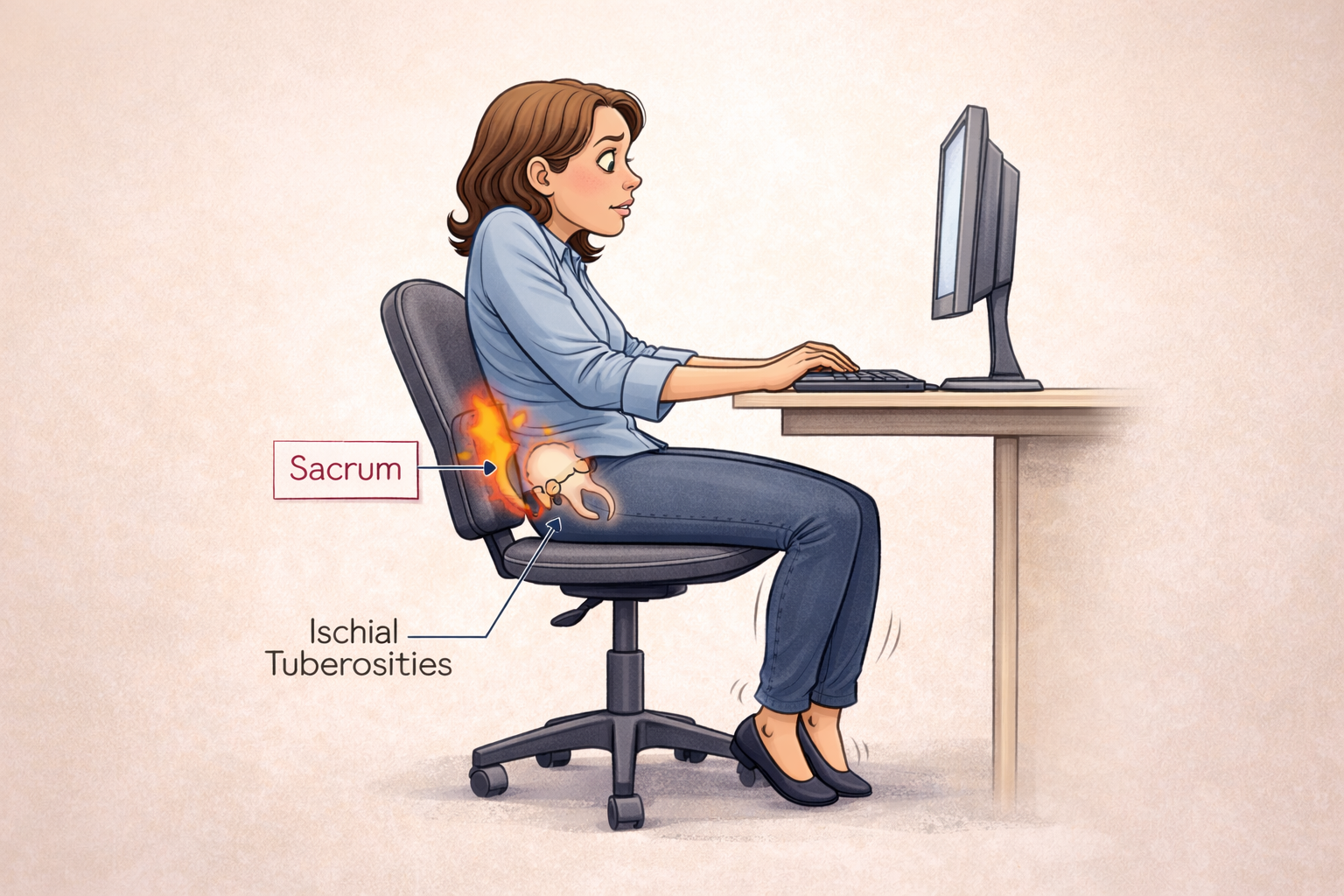
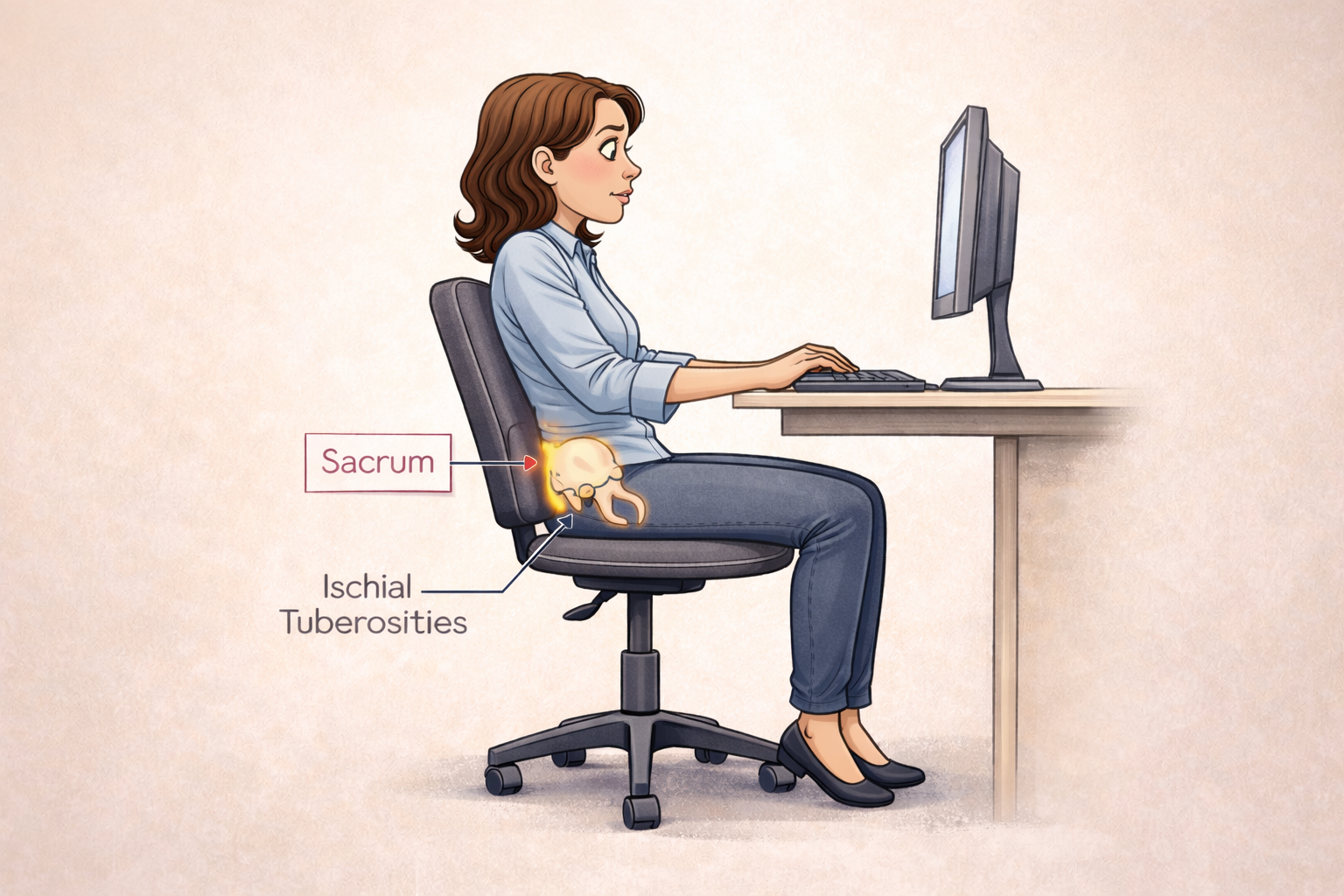
If you sit slumped back on your tailbone (your sacrum) instead of upright on your sit bones (your ischial tuberosities), you're putting your pelvic floor in a position where it literally cannot fire properly.
Think of it this way: if you tuck your tailbone under and round your lower back, your pelvic floor muscles are already in a shortened, "scrunched" position. They have no room to contract further. They're mechanically disadvantaged.
Sitting upright on your sit bones allows your pelvis to be in a neutral position. Your pelvic floor can move through its full range. It can do its job.
This doesn't mean you have to sit in perfect posture all day, that's exhausting and unrealistic. But becoming aware of how you sit, and making small adjustments throughout the day, can make a real difference
Breath Holding and Bracing
Do you hold your breath when you:
- Lift something heavy?
- Concentrate hard on a task?
- Feel stressed or anxious?
A lot of women do. It's a natural response. But when you hold your breath, you create a pressure build; up in your abdomen. Remember that canister we talked about?
If you lock the top, by holding your breath, the pressure has to go somewhere. And it usually goes down, onto your pelvic floor.
Over time, this repetitive pressure can weaken the system.
The solution isn't to never lift anything or never concentrate. It's to learn to breathe through effort. Exhale as you lift. Exhale as you stand up from a chair. Exhale as you sneeze, if you can catch it.
It sounds simple, but it's a game; changer.
SECTION 8: Reframing the Goal
What "Healing" Actually Looks Like
We started this module by talking about the "weakness myth." Now that you understand how complex the pelvic floor system actually is, let's reframe what we're working toward.
The goal isn't to "fix" your pelvic floor.
The goal is to restore system harmony.
That means:
- Your breathing and your pelvic floor move in sync
- Your nervous system feels safe enough to let your pelvic floor relax
- Your tissues are healthy, hydrated, and supported by adequate hormones
- Your fascia is resilient and adaptable
- Your daily habits support, rather than undermine, your pelvic health
- Your pelvic floor has both strength AND flexibility, not just one or the other
When all of these pieces come together, your pelvic floor doesn't have to work so hard. It can go back to its natural job: being a responsive, adaptive, supportive foundation for your life.
You might still leak occasionally. Let's be real, most people do at some point. But you'll have the tools to understand why, and to make adjustments.
You might still have days where symptoms flare. (Healing isn't linear.) But you'll know it's not because you're broken. It's just information.
And most importantly, you'll trust your body again. Not because it's perfect. But because you understand it.
Key Takeaways from Module 1
Let's recap what we've covered:
✅ The pelvic floor isn't just one muscle. It's a complex, multi-layered system that works as part of your core "pressure canister."
✅ "Just do Kegels" fails most women because it ignores breathing, posture, nervous system state, hormones, fascia, and coordination.
✅ Many women have tight pelvic floors, not weak ones. If your muscle is already maxed out, squeezing harder makes things worse.
✅ Your nervous system plays a huge role. If you're chronically stressed, your pelvic floor is chronically guarding. You have to calm the system before you can strengthen it.
✅ Hormones matter, especially estrogen. Thin, dry tissues can't "seal" properly, no matter how strong your muscles are.
✅ Fascia provides the passive support that muscles can't. You support fascia through movement, hydration, and nutrition, not through squeezing.
✅ Small daily habits add up. "Just-in-case" peeing, breath-holding, and poor posture all contribute to pelvic dysfunction over time.
✅ The goal is system harmony, not perfection. When all the parts work together, your pelvic floor can do its job without working overtime.
Reflection Questions
Before moving on to Module 2, take a moment to think about:
- Which part of this lesson surprised you most? Was there a concept that made you think, "Wait, no one ever told me that"?
- Do you recognize any of the patterns we talked about in your own life? (Chronic stress? Breath; holding? "Just; in; case" peeing? Tucked tailbone posture?)
- How does it feel to know that your symptoms aren't about weakness? Does it change how you think about your body?
- What's one small thing you could start paying attention to this week? (How you breathe? How you sit? How often you pee?)
There's no right answer. Just your answer.
What's Next?
Now that you understand how the pelvic floor system actually works, we need to talk about one of the most overlooked factors in pelvic health: hydration.
In Module 2, we're going to bust some dangerous myths about water intake and incontinence. You'll learn why "drinking less water" is terrible advice, what actually happens when you're dehydrated, and how proper hydration supports your tissues, your bladder, and your entire pelvic system.
Spoiler: the solution isn't drinking more water, though that might be part of it. It's about drinking smarter.

0 Comments